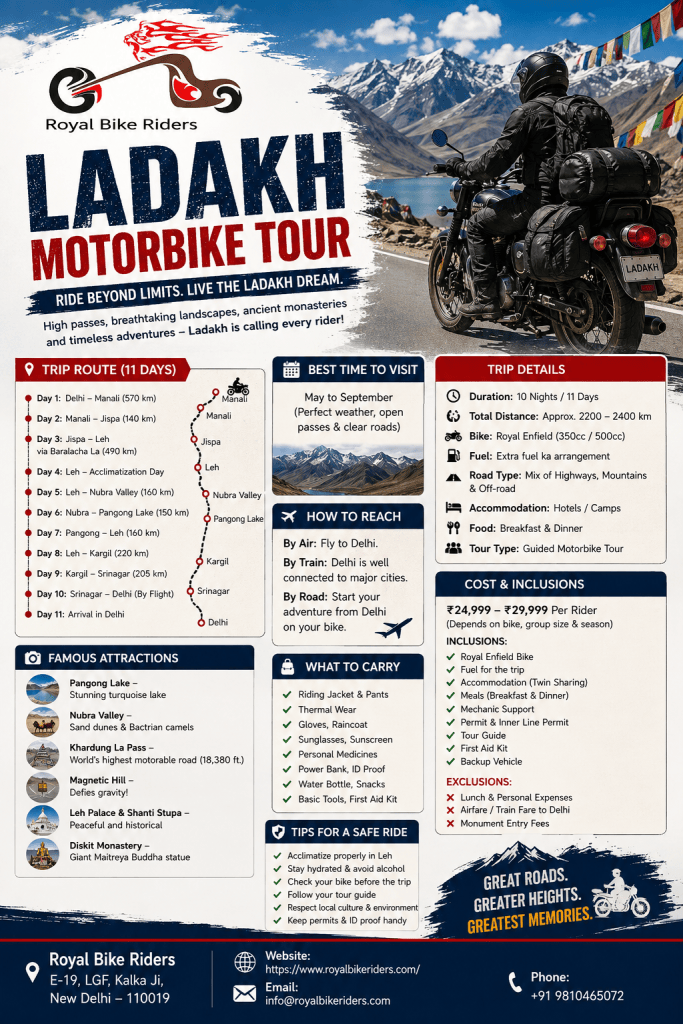
Most guides to a Ladakh motorbike tour read like checklists: best season, best route, best gear. All useful, none of it tells you what the days actually feel like once you’re on the road. This guide takes a different approach. Instead of listing facts in isolation, it walks through a typical Ladakh motorbike tour more or less in the order you’d experience it, from the first climb out of Manali to the final descent back to lower altitude, with the practical details woven in where they’d naturally come up.
Royal Bike Riders has been running tours through this region for years, and the structure below reflects roughly how a well-paced itinerary unfolds. Whether you end up riding independently or with an organized group, understanding the rhythm of the trip beforehand makes a real difference to how prepared you feel once you’re actually on the bike.
Before the Wheels Turn: Getting the Basics Right
Before any discussion of routes or passes, three things need to be settled: when you’re going, what you’re riding, and what paperwork you’ll need.
Timing matters more here than on most trips. A Ladakh motorbike tour is only realistic between June and September, since the high passes remain snowbound outside this window. July and August are peak seasons, with the most stable weather and fully open roads, while June and September offer quieter routes at the cost of slightly less predictable conditions.
The motorcycle most riders choose is a Royal Enfield, typically the Himalayan, Classic 350, or a similarly rugged model. These bikes handle the mix of tarmac, gravel, and water crossings better than most alternatives, and parts are easy to source even in small Ladakhi towns if something goes wrong.
Permits are non-negotiable for certain zones. Nubra Valley, Pangong Tso, and areas near Khardung La fall under restricted regions requiring an Inner Line Permit, and foreign nationals typically need a Protected Area Permit as well. You’ll need a government photo ID, passport photographs, and your vehicle’s registration and insurance documents to apply.
Day One and Two: Climbing Out of Manali
Most Ladakh motorbike tours begin in Manali, sitting at a comfortable 2,050 meters. The road out of town climbs almost immediately, and Rohtang La is usually the first real test: the air thins, the vegetation disappears, and the road narrows into a single mountain-hugging lane. This is where most riders get their first genuine taste of high-altitude riding, and where the trip starts feeling like something different from ordinary touring.
Past Rohtang, the road drops into the Lahaul Valley, a green, irrigated stretch that feels almost like a pause before the terrain turns properly barren again. From there, the climb toward Baralacha La, sitting close to 4,900 meters, is often where riders first notice their body responding to the thinning air, a slight headache, mild fatigue, nothing alarming if you’ve paced the ascent sensibly.
By the end of day two, most itineraries reach Sarchu, a high-altitude camp where temperatures drop sharply after sunset regardless of the season. It’s not a comfortable night by most standards, but it’s the kind of discomfort that tends to make the following day’s ride feel earned.
Day Three: Into Leh
The stretch from Sarchu toward Leh passes through the Gata Loops and Nakee La, widely considered one of the more dramatic sections of road on the entire route. Switchback after switchback climbs and drops through terrain that looks more lunar than mountainous.
Leh itself sits at roughly 3,524 meters and functions as the natural hub for the rest of the trip. Riders arriving via Manali are generally already acclimatized by this point, but most well-run itineraries still build in a rest day or two here regardless, partly for the body, partly because Leh’s old market, with its pashmina shawls, dried apricots, and Tibetan jewelry, is worth wandering through without a schedule pressing on you.
Day Four and Five: Khardung La and Nubra Valley
This is where many riders say the trip actually peaks, contrary to what first-timers often assume. Khardung La, marketed widely as one of the highest motorable passes in the world at approximately 5,359 meters, serves as the gateway north from Leh.
The descent on the far side into Nubra Valley is one of the more striking stretches of riding anywhere in the region: switchbacks dropping through eroded ridgelines into a wide valley floor where double-humped Bactrian camels graze against a backdrop of sand dunes and distant snow peaks. It’s an incongruous landscape, desert and glacier within sight of each other, and most riders spend a full day here before heading back toward Leh.
Day Six: Pangong Tso
A few hours east of Leh, crossing Chang La pass, sits Pangong Tso, a long, narrow lake stretching from India into China. The water shifts color through the day, turquoise in the morning, deep blue by noon, and most well-paced Ladakh motorbike tours build in an overnight stay here rather than a rushed visit, since the early morning light on the lake is genuinely different from what you’ll see at midday.
Sitting beside the water with the bike parked nearby, with nothing but mountains on the far shore, is the moment many riders point to afterward as the trip’s defining image.
Day Seven Onward: Heading Back or Going Further
From here, itineraries typically branch. Shorter tours begin the journey back toward Leh and eventually Manali or Srinagar. Longer tours, usually 12 days or more, push further to Tso Moriri, a quieter, less developed lake south of Leh that appeals to riders wanting a more remote experience away from the main circuit.
Either way, the return leg usually retraces familiar passes, though descending after days at altitude tends to feel noticeably easier on the body than the climb did.
The Parts That Don’t Show Up in the Day-by-Day
A few practical realities apply across the entire trip, regardless of which day you’re on.
Altitude sickness is a genuine risk, not a remote possibility, and it affects fit riders as much as anyone else. Ascending slowly, staying hydrated, avoiding alcohol for the first few days, and taking symptoms like headaches or nausea seriously rather than pushing through them is what keeps a Ladakh motorbike tour safe rather than risky.
Weather can shift quickly near high passes even during peak season. Clear mornings can turn into sudden hail or rain by afternoon, so weatherproof riding gear isn’t optional.
Mechanical issues happen on mountain roads; it’s a matter of when, not if. Traveling with a group or operator that carries spare parts and has a support vehicle nearby matters more here than on most other Indian touring routes.
What to Pack
- Full riding gear: helmet, armored jacket and pants, gloves, sturdy boots
- Layered clothing with a windproof, waterproof outer shell
- Altitude sickness medication, following a doctor’s advice
- Sunscreen and UV-protection sunglasses, since sun exposure intensifies at altitude
- A reusable water bottle or hydration pack
- Basic toolkit, puncture repair kit, and tow rope if riding independently
- Power bank and offline maps for stretches with no network coverage
Why Riders Choose to Do This With Royal Bike Riders
A Ladakh motorbike tour can absolutely be planned independently, but the margin for error at this altitude, on these roads, is smaller than most riders expect. Royal Bike Riders has run tours through this region for years, and the value shows up less in the riding itself and more in what surrounds it: permits arranged in advance, motorcycles serviced and carrying critical spares, road captains trained in altitude management, and rest days that are actually protected rather than sacrificed to save time.
For riders attempting Ladakh for the first time, or experienced riders who’d simply rather focus on the road than the logistics, that structure tends to be the difference between a trip that runs smoothly and one derailed by an avoidable problem.
Final Thoughts
A Ladakh motorbike tour isn’t a single dramatic moment; it’s a sequence of days, each with its own character, building toward an experience that’s hard to replicate anywhere else. The climb out of Manali, the high camp at Sarchu, the descent into Nubra, the quiet morning beside Pangong Tso, each day adds something different, and together they explain why riders who’ve done this trip once so often find themselves planning a return. Whether you ride it independently or with an experienced team like Royal Bike Riders, the preparation you put in beforehand shapes how much you actually get to enjoy once you’re finally on the road.
Frequently Asked Questions (FAQs)
1. What is the best time for a Ladakh motorbike tour? June through September, with July and August offering the most stable weather and fully open high-altitude passes.
2. How many days does a typical Ladakh motorbike tour take? Most itineraries run 9 to 12 days, with extended versions covering 12 or more days if Tso Moriri is included.
3. Which motorcycle is best suited for this route? Royal Enfield models such as the Himalayan and Classic 350 are the most common choices due to their durability and easy access to spare parts.
4. Do I need permits for a Ladakh motorbike tour? Yes, an Inner Line Permit is required for restricted zones like Nubra Valley and Pangong Tso, and foreign nationals typically need a Protected Area Permit as well.
5. Is altitude sickness a serious concern? Yes, and it can affect fit riders as much as anyone else. Proper acclimatization, hydration, and taking early symptoms seriously are essential.
6. Which route should I take into Ladakh? Most riders enter via Manali for a dramatic, high-altitude start, though a Srinagar entry offers a gentler ascent for those who prefer it.
7. Is prior riding experience necessary? Yes, ideally. Comfort with long distances, gravel, and steep inclines matters significantly on this route.
8. Should I book a guided tour or plan independently? Guided tours with an experienced operator like Royal Bike Riders are especially helpful for first-timers, since they handle permits, acclimatization schedules, and mechanical support.
9. What should I pack for the trip? Proper riding gear, altitude medication, sun protection, layered clothing, and a basic toolkit if traveling independently.
10. What are the trip’s most memorable stops? Khardung La, Nubra Valley, and Pangong Tso are consistently mentioned by riders as the highlights of a Ladakh motorbike tour.
Royal Bike Riders
E-19, LGF, Kalka Ji, New Delhi – 110019
Website: https://www.royalbikeriders.com/
Email: info@royalbikeriders.com
Phone: +91 9810465072

