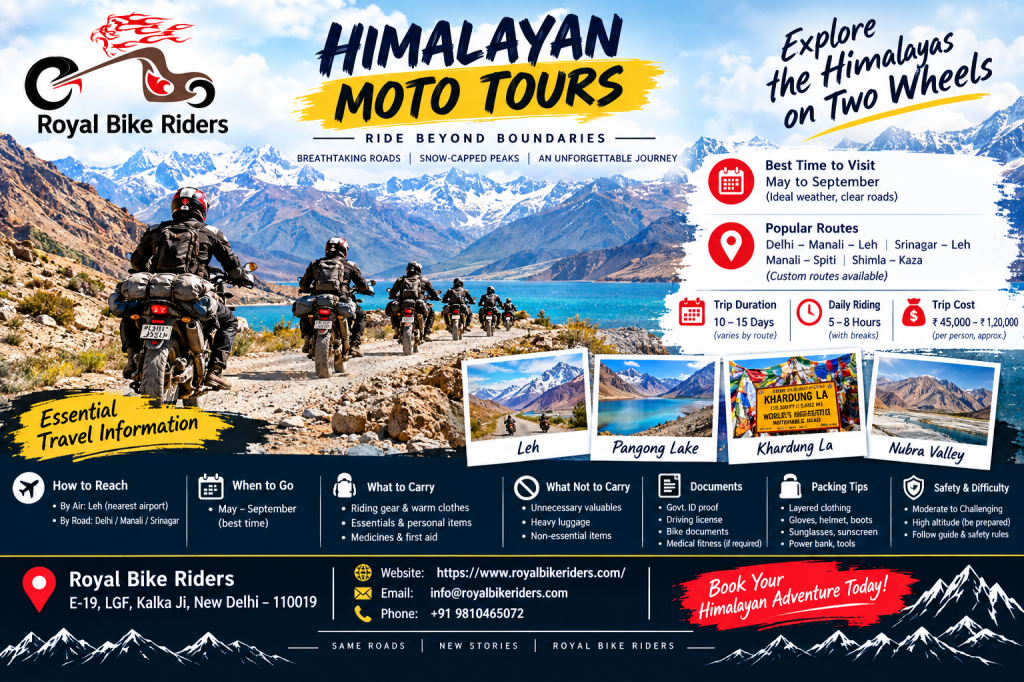
The Himalayas don’t hand out easy rides. They offer something better: roads that make you feel small, passes that make you feel capable, and evenings that remind you why you left the city in the first place. Himalayan Moto Tours turn that raw experience into something a rider can actually plan for, with support, structure and local knowledge behind the throttle.
This guide is written for riders who want detail before they commit. It covers how these tours are built, how regions differ, what altitude does to you and your bike, how to compare tour styles, and how to prepare properly. It also explains how Royal Bike Riders, a New Delhi-based operator, approaches supported motorcycle journeys in the mountains.
How Himalayan Moto Tours Are Put Together
A good tour is more than a route on a map. Behind every itinerary sit decisions about daily distance, altitude gain, rest days, fuel availability, overnight stays and what to do if the weather turns.
Most supported tours share a few building blocks:
- A route leader who knows the road and sets the pace
- A planned daily schedule that balances riding with rest
- Overnight stays arranged in advance in places where options are limited
- A support vehicle carrying spares and, in some cases, luggage
- Daily briefings so riders know what the next stretch demands
The Royal Bike Riders website describes its Himalayan expeditions along these lines, with a maintenance vehicle that follows the group and a briefing the night before each day’s climb. Exact inclusions vary by tour, so always confirm what is covered for the specific departure you’re considering.
Choosing a Region: What Each Part of the Himalayas Offers
“The Himalayas” covers a huge area, and the riding changes dramatically from one region to the next.
Ladakh: The Classic
Ladakh is where most riders start. Leh sits at roughly 3,500 metres, and from there you can reach Nubra Valley, Pangong Tso, Tso Moriri and a string of monasteries. The scenery is high-altitude cold desert: rust-coloured mountains, wide valleys and brilliant lakes. Roads are a mix of smooth tarmac and rougher patches. Royal Bike Riders lists Leh Ladakh motorcycle tour pages and a Little Tibet ride for this region.
Spiti and the Trans-Himalaya: The Remote Option
If Ladakh is the classic, Spiti is the quieter cousin. Villages are small, distances between services are long and the roads can be rough. It suits riders who prefer solitude and don’t mind basic stays. The operator’s Trans-Himalaya Adventure Ride covers this style of terrain.
High-Altitude Challenge Rides
A few tours are designed around altitude itself. Royal Bike Riders lists a ride built around Umling La at 5,798 metres and another called World Highest Ride in Himalayas. These are for experienced riders with strong mountain skills who understand how thin air changes everything.
Royal Enfield Mountain Tours
For riders who want the classic Enfield experience on Himalayan roads, the operator offers Rediscover Himalaya on Royal Enfield and has dedicated Royal Enfield tour pages.
Warm-Weather Options
When the mountains are closed or you want to build experience first, Royal Bike Riders also runs tours in Rajasthan and South India, including a Coconut and Tea Route.
Season by Season: When Each Month Works
The riding window is short and the Himalayas keep their own calendar.
Late May to June. High roads are opening up. Expect frosty mornings, snow banks beside the road and thinner crowds. Conditions can be unpredictable, so flexibility is essential.
July and August. The lower approaches can see heavy monsoon rain and landslides, but trans-Himalayan zones like Ladakh sit in a rain shadow and are comparatively dry.
September. Skies are often settled and the light is rich. Nights are cold, and weather can turn quickly toward the end of the month.
October onward. Early snowfall can close passes at short notice. This period is best left to experienced riders with flexible plans.
Dates and road conditions change every year, so check the operator’s tour calendar and ask about current road status before you book.
Altitude Explained for Riders
Altitude is the one factor riders consistently underestimate. Above roughly 3,500 metres the body notices the reduced oxygen, and several Himalayan passes sit well above 5,000 metres.
Approximate Altitudes You May Encounter
These figures are approximate and widely quoted, so verify them before publishing or planning around them.
| Location | Approximate height |
| Leh | 3,500 m |
| Pangong Tso | 4,225 m |
| Tso Moriri | 4,520 m |
| Baralacha La | 4,890 m |
| Tanglang La | 5,330 m |
| Khardung La | 5,360 m |
What Altitude Does to You
Common early signs of altitude trouble include headache, nausea, dizziness, poor sleep and unusual breathlessness. Fitness doesn’t protect you, and there’s no reliable way to predict who will be affected.
Sensible habits help:
- Gain altitude gradually and rest early in the trip
- Drink water steadily, even when you don’t feel thirsty
- Avoid alcohol and heavy exertion in the first days
- Eat regular, light meals
- Tell your route leader early if you feel unwell
- Consult a doctor before travelling, especially if you have heart, lung or blood pressure conditions
If symptoms worsen, descending is the safest response.
What Altitude Does to Your Bike
Engines make less power in thin air. Expect slower climbs, avoid hard revving and use lower gears sensibly. Riders who stay calm on the throttle usually finish the day less exhausted.
Guided Tour or Solo Ride? An Honest Comparison
| Factor | Guided tour | Independent ride |
| Planning effort | Mostly handled by the operator | Entirely on you |
| Backup | Support vehicle and team | Depends on your own preparation |
| Flexibility | Fixed itinerary | Complete freedom |
| Local knowledge | Route leaders and briefings | Research and word of mouth |
| Permits | Often assisted | Self-arranged |
| Social side | Built-in group | Solo or small private group |
Neither option is better for everyone. A guided Himalayan motorcycle tour suits riders who want support and fewer variables. Independent riding suits experienced travellers who enjoy planning and can handle a breakdown alone.
Motorcycle Choice: Reliable Over Powerful
You don’t need a big, fast machine in the mountains. What matters is reliability, ground clearance, comfortable ergonomics and ease of repair. Torque-friendly single-cylinder tourers and adventure bikes are common choices because they cope well with slow climbs and rough surfaces.
If you bring your own bike, arrange a full service, check tyres, brakes, chain and cables, and carry a basic toolkit and puncture kit. If you join a tour that supplies bikes, ask which models are available and how they are maintained. Royal Bike Riders has a dedicated bikes page on its website, and the team can confirm current options.
Rider Fitness and Skills
You don’t need to be an athlete, but long days at altitude are tiring in ways flat touring isn’t.
- Cardio: Regular aerobic exercise in the weeks beforehand helps with stamina
- Core and leg strength: Improves posture and bike control
- Gravel practice: Rough-surface experience makes a real difference
- Loaded-bike riding: Get used to handling extra weight
- Honest self-assessment: Choose a tour that matches your actual level
Permits and Paperwork
Certain areas near the border require special permits, and rules or fees can change. Confirm current requirements before you travel.
Carry:
- Valid driving licence
- Passport or government photo ID
- Motorcycle registration and insurance (if riding your own bike)
- Travel insurance details
- Printed permit copies and a few photocopies of everything
- Emergency contacts
Many operators assist with permits, but ask exactly what’s included rather than assuming.
Packing List for Himalayan Moto Tours
Temperatures can swing from freezing to warm and back within a single day, so pack layers rather than one heavy jacket.
Protection
- Certified helmet
- Armoured jacket and riding pants
- Gloves, boots and knee guards
Layers
- Thermal base layer
- Fleece or insulating mid-layer
- Windproof and waterproof shell
- Balaclava or neck gaiter
Health
- High-SPF sunscreen and lip balm
- Moisturiser for dry air
- Personal medicines and a small first-aid kit
- UV-protective sunglasses
Practical items
- Power bank and offline maps
- Torch or headlamp
- Reusable water bottle
- Dry bags or waterproof liners
- Some cash, as ATMs are scarce in remote areas
Royal Bike Riders also publishes a riding kit page that’s worth cross-checking with your own list.
A Sample Day on a Himalayan Motorcycle Tour
This is an illustrative day, not a specific itinerary.
Early morning: Wake before sunrise, eat a simple breakfast and attend the briefing covering distance, altitude and road conditions.
Morning ride: Set off in a loose formation, with regroup stops at viewpoints and river crossings.
Midday: Lunch at a roadside stop or small village, with time to rest and rehydrate.
Afternoon: Often the hardest stretch, when fatigue and thin air peak. Pacing matters here.
Evening: Reach the stay, check the bike, eat well and stretch. Conversation around the table tends to be a highlight.
Night: Early sleep, because the next day starts early as well.
Safety Habits That Matter
- Start early and aim to finish before the weather changes
- Keep left and slow down for blind corners
- Watch for trucks, army convoys and animals
- Avoid riding after dark
- Cross water carefully, since streams swell as glaciers melt during the day
- Keep spacing in the group and follow the route leader
- Stop when tired rather than pushing on
- Stay hydrated and eat properly
Planning Checklist
- Decide which region and difficulty level suit you
- Pick a season and check road status
- Compare tour inclusions and terms
- Confirm bike options and riding kit requirements
- Sort permits, insurance and documents
- Begin fitness preparation weeks ahead
- Pack in layers and use waterproof bags
- Build a buffer day into your travel plans
Why Riders Choose Royal Bike Riders
Royal Bike Riders Pvt. Ltd. is based in New Delhi and organises motorcycle tours across the Himalayas, Rajasthan and South India. For Himalayan Moto Tours, its website highlights:
- Supported expeditions with a trailing maintenance vehicle
- Experienced route leaders
- A range of tours, from Little Tibet to high-altitude and Royal Enfield rides
- Evening briefings before each day’s ride
- Useful resources such as a tour calendar, riding kit list, FAQs, testimonials and photo and video galleries
You can explore tours and departures on the Royal Bike Riders Himalayan Moto Tours and contact the team to confirm dates, inclusions and bike choices.
Conclusion
Himalayan Moto Tours reward riders who prepare well, pace themselves and respect the terrain. Choose a region and difficulty that match your real experience, take acclimatisation seriously, pack for extreme swings in weather and keep your expectations flexible. With a supported operator like Royal Bike Riders handling the logistics, you can put your attention where it belongs: the road, the landscape and the company around you.
Frequently Asked Questions
1. What are Himalayan Moto Tours?
They are organised motorcycle journeys through Himalayan regions such as Ladakh, Spiti and Little Tibet, typically including route planning, accommodation and on-road support.
2. Which region is best for a first Himalayan motorcycle tour?
Ladakh is the most popular choice thanks to its infrastructure and scenery. Rider experience should guide the final decision.
3. How high do these tours go?
Several passes exceed 5,000 metres. Royal Bike Riders lists an Umling La ride at 5,798 metres, which is aimed at experienced riders.
4. What is the best time for Himalayan Moto Tours?
Roughly late May to September, with September popular for clear skies. Conditions vary each year.
5. Do I need previous mountain riding experience?
It’s strongly recommended. Comfort with manual gears, gravel and long days helps a great deal.
6. Are permits required?
Restricted areas need permits. Rules change, so confirm them in advance or ask the operator.
7. Can I take my own motorcycle on a guided tour?
That depends on the operator and tour. Confirm directly with Royal Bike Riders.
8. How can I prevent altitude sickness?
Acclimatise gradually, drink water, avoid alcohol and overexertion, and see a doctor before the trip. Descend if symptoms get worse.
9. What should I wear?
Layers topped with a windproof and waterproof shell, plus certified riding gear, sun protection and warm gloves.
10. How do I book with Royal Bike Riders?
Browse tours and departures on the Royal Bike Riders website, then contact the team to confirm details before booking.
Royal Bike Riders
E-19, LGF, Kalka Ji, New Delhi – 110019
Website: https://www.royalbikeriders.com/
Email: info@royalbikeriders.com
Phone : +91 9810465072

