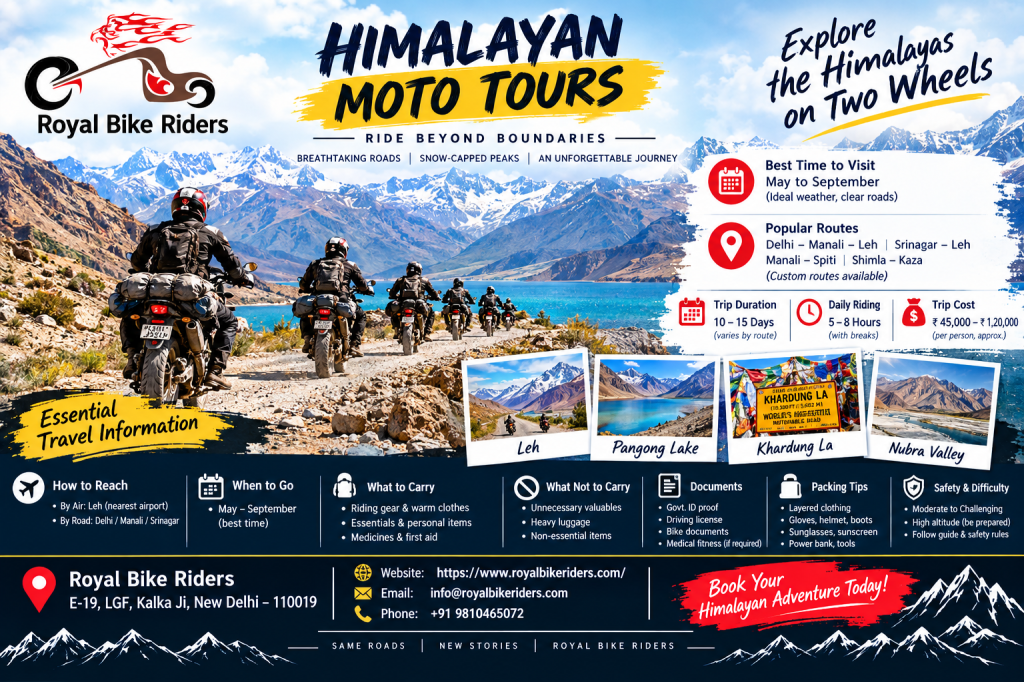
At some point on a mountain road, the engine settles into a rhythm, the hairpins stop feeling like obstacles and the whole landscape seems to open up around you. That feeling is what draws riders to Himalayan moto tours. The roads are rough, the air is thin and the scale is enormous, yet the reward is one of the most vivid journeys a motorcyclist can take.
This guide explains what these tours involve, which regions and routes to consider, when to go, how to prepare and what to ask before you book. It also shows how Royal Bike Riders organise its Himalayan journeys.
What Are Himalayan Moto Tours?
Himalayan moto tours are organised motorcycle journeys through the high mountain regions of northern India. Rather than planning everything yourself, you join a route designed in advance, with accommodation, daily briefings, support vehicles and experienced leaders handled by the operator.
The appeal is practical as much as romantic. Fuel stops can be hundreds of kilometres apart, mechanics are scarce at altitude, weather changes without warning and some regions need permits. A structured tour takes care of these realities so you can concentrate on riding.
Why Riders Choose a Guided Tour Over Going Solo
Riding independently has its charm, and some riders do it well. But a guided Himalayan tour offers advantages that are hard to match alone:
- Support vehicle: Spares, tools and luggage travel with the group.
- Route knowledge: Leaders who have crossed these passes many times understand road conditions, weather patterns and alternatives when a road closes.
- Mechanical backup: A problem on a remote stretch becomes a manageable delay instead of a crisis.
- Daily briefings: You know the distance, altitude gain and conditions before you set off.
- Company: Shared effort at altitude tends to build friendships quickly.
Royal Bike Riders describes its Himalayan expeditions as fully supported, with experienced route leaders and a maintenance vehicle that follows the group.
Himalayan Routes and Tour Styles
The Himalaya is not one ride. It is a collection of very different journeys. Royal Bike Riders lists several tours that illustrate the range.
Ladakh Circuits
Ladakh is the best-known destination, with Leh as a base and rides to Khardung La, Nubra Valley and Pangong Lake. It combines dramatic passes with monasteries and village life, and it suits riders who want the classic Himalayan experience.
Thrilling Himalaya: Umling La at 5,798 Metres
For experienced riders who want to go higher, this tour is built around Umling La at 5,798 metres. It demands strong preparation and respect for altitude.
World Highest Ride in Himalayas
This tour focuses on some of the highest roads in the range. It is intended for riders who are comfortable with long days and demanding conditions.
Ride High Through Little Tibet
This route explores the remote, Tibetan-influenced landscapes of the region, with quieter roads, stark scenery and an emphasis on culture as well as riding.
Trans-Himalaya Adventure Ride
A longer journey that crosses several mountain regions, suited to riders with time to spare and the stamina for extended days.
Rediscover Himalaya on Royal Enfield
A broader introduction to the range of Royal Enfield motorcycles, useful for riders who want a well-rounded first experience.
Check each tour’s page on the Royal Bike Riders website for exact itineraries, durations and difficulty before choosing.
What Makes Himalayan Riding Different
Many destinations offer scenery. The Himalaya offers scale. Rivers cut turquoise ribbons through deep gorges, prayer flags snap in the wind on passes higher than most people will ever stand, and small villages appear in the middle of nowhere with tea stalls that have served travellers for generations.
Riding here is also physically different. There is little relaxed cruising. You climb in low gears, brake carefully on loose gravel, cross streams and adjust constantly to the road. It rewards patience and punishes impatience, which is part of why finishing a tour feels so satisfying.
Best Time for Himalayan Moto Tours
Snow closes many high passes in winter, so the riding season is limited. In general, Himalayan moto tours run from about June to September.
- June: Cooler and quieter, often good road conditions, with snow possible near high passes.
- July and August: Warmest and busiest, though weather elsewhere in the Himalaya can affect approach roads.
- September: Clear skies and crisp light, with colder nights and rising chance of early snow.
Passes can open late or close early depending on the year, so ask your operator about the outlook for your dates and keep your schedule flexible.
A Typical Day on the Road
While every itinerary differs, many days follow a familiar pattern.
Early morning: Breakfast and a short briefing covering distance, altitude gain, road conditions and the planned lunch stop. Starting early matters because mountain weather is usually kindest in the first hours.
Midday: Riding in a loose formation, regrouping at viewpoints and river crossings, with regular breaks for water and photographs.
Afternoon: Often the hardest climbs, when thin air makes even small efforts tiring. Steady pacing and constant hydration help more than horsepower.
Evening: Arrival at the next stop in daylight, a hot meal, conversation with fellow riders and an early night.
Altitude and Weather: The Honest Risks
Altitude is the biggest factor in Himalayan riding. Above roughly 3,500 metres, the body needs time to adapt, and rushing is the most common reason trips are cut short. Symptoms can include headaches, nausea, dizziness, unusual breathlessness and poor sleep.
Sensible habits help:
- Gain height gradually and respect rest days.
- Drink water steadily, even when it is cold.
- Avoid alcohol early in the trip.
- Eat regularly, even if appetite drops.
- Tell your leader about symptoms immediately and never push through worsening signs.
Weather is the second risk. Sudden snowfall on a high pass can close a road for hours or longer, even in season. Good itineraries include buffer days, and good leaders know contingency routes.
Which Rider Level Suits Himalayan Moto Tours?
These tours are not usually recommended as a first ever ride, but they are not reserved for extreme adventurers either. You should be comfortable with a manual gearbox, have some experience on uneven or unpaved surfaces and be reasonably fit. Many moderately experienced riders complete Himalayan routes every season with preparation, steady pacing and strong support.
A simple way to judge yourself:
- Newer rider: Build mileage and confidence on easier routes first.
- Intermediate rider: A standard Himalayan circuit with good support is a realistic goal.
- Experienced rider: Consider higher, tougher tours such as the Umling La ride.
Motorcycles for the Mountains
Reliability, ground clearance and torque matter more than top speed. Royal Enfield motorcycles are a long-standing favourite because they are tough, simple and familiar to mechanics across the region. Royal Bike Riders says its fleet is checked before departure and serviced during the trip, and mentions Himalayan and Classic 350 models on its tours, with the exact bike depending on availability and group preference. Ask which model you will get and how recently it was serviced.
Gear for Extreme Swings in Temperature
It is common to start a day in a fleece at a few degrees above freezing and finish it in a T-shirt in warm sunshine, then watch temperatures drop again after sunset. Layering is essential:
- Base layer: Moisture-wicking thermal
- Mid layer: Fleece or insulated jacket
- Outer layer: Windproof, waterproof, armoured jacket and trousers
- Hands: Gloves warm enough for cold mornings but precise enough for clutch and brake control
- Feet: Supportive riding boots and warm socks
- Head and face: Certified helmet, buff or balaclava and sunglasses
- Extras: Strong sunscreen, lip balm, headlamp, power bank and personal medication
Royal Bike Riders has a riding kit page that works as a handy checklist.
Permits and Documents
Carry your motorcycle licence, photo ID and booking confirmation. International riders usually also need a passport, visa, international driving permit and travel insurance. Some restricted zones need permits, and rules and fees change, so ask your operator what they arrange and what you handle yourself.
How to Choose a Himalayan Moto Tour Operator
Compare operators on substance, not slogans. Ask:
- Is a support vehicle with spares present every day?
- Is there a mechanic who knows the bikes?
- What medical supplies and first-aid knowledge does the team have?
- Are acclimatisation and buffer days included?
- How experienced are the route leaders on this specific route?
- What exactly is included and excluded, in writing?
- What happens if a rider falls ill or a bike cannot continue?
Clear answers to these questions are a good sign. Vague ones are not.
Why Choose Royal Bike Riders
Royal Bike Riders, based in New Delhi, organises guided Royal Enfield tours across the Himalaya, South India and Rajasthan. Its Himalayan trips pair experienced route leaders with a support vehicle and maintained motorcycles, with accommodation, route planning and logistics arranged by the team. The website lets you check the tour calendar, view photos and videos, read testimonials and review the necessary-information page before you commit, which makes comparing options far easier.
Conclusion
Himalayan moto tours are less a holiday than a test of preparation and adaptability, and that is exactly why riders return to them. Pick a route that matches your experience, travel in the right season, give your body time to adjust to altitude and choose an operator with real backup. With careful planning and a team like Royal Bike Riders behind you, the mountains stop being an obstacle and become your road.
Frequently Asked Questions (FAQs)
1. What are Himalayan moto tours?
They are guided motorcycle journeys through the high mountain regions of northern India, with routes, accommodation and support arranged by an operator.
2. When is the best time for Himalayan moto tours?
Generally June to September, when high passes are open. Exact conditions vary every year.
3. Are Himalayan moto tours suitable for beginners?
They are better suited to riders with solid basic skills and some experience on uneven surfaces. Newer riders should consider easier routes first.
4. Which tours does Royal Bike Riders offer in the Himalaya?
Examples include the Umling La ride at 5,798 metres, World Highest Ride in Himalayas, Ride High Through Little Tibet, Trans-Himalaya Adventure Ride and Rediscover Himalaya on Royal Enfield.
5. What support comes with a guided tour?
Royal Bike Riders describes experienced route leaders and a support vehicle following the group with spares. Confirm exact inclusions for your departure.
6. How do I avoid altitude sickness?
Ascend gradually, rest when scheduled, drink water, avoid alcohol early on and report symptoms right away.
7. What motorcycles are used?
Royal Bike Riders mentions Royal Enfield models such as the Himalayan and Classic 350, depending on availability and group preference.
8. Do I need permits?
Some restricted areas require permits. Ask your operator what they arrange and what you must organise.
9. What should I pack?
Certified riding gear, layered clothing, sun protection, personal medication and printed copies of your documents.
10. How do I book?
Check the tour calendar on the Royal Bike Riders website, choose a route and contact the team to confirm availability.
Royal Bike Riders
Address : E-19, LGF, Kalka Ji, New Delhi – 110019
Website: https://www.royalbikeriders.com/
Email: info@royalbikeriders.com
Phone : +91 9810465072

